




7.5

Expert Trainers

Proven Strategies

High Success Rate
 Proud Moment!
7.5

8.0

8.0

6.5

7.0
you can be next!

Trusted by 1000+ Students


Walk down any market road in Pune, Nashik or Nagpur and you will spot at least three banners promising “IELTS 8 Bands Guaranteed.” Pick the wrong one and you lose six months, your test fee, and worst of all, your admission intake.
Choosing the best IELTS classes in Maharashtra is not about who has the loudest hoarding — it is about who actually corrects your Writing Task 2, who makes you speak for 11 minutes without freezing, and who tells you the truth about your current band. This guide walks you through exactly what to check before you enrol anywhere in the state.
The best IELTS classes in Maharashtra combine small batches of 12–15 students, trainers who personally evaluate your Writing and Speaking, weekly full-length mock tests under exam conditions, and honest band diagnostics before enrolment. Prioritise institutes offering daily speaking practice and written feedback over those advertising guaranteed scores or unusually large classroom sizes.
It is confusing because most institutes market the outcome, not the method. Everyone promises bands. Very few explain how many essays you will write, who corrects them, or how often you will speak aloud. Without visibility into the actual teaching process, learners end up comparing prices instead of comparing preparation quality.
Take Sneha, a B.Sc. Nursing graduate from Katraj, Marathi-medium background. Solid grammar. Fast reading. But in her first mock Speaking test she managed 40 seconds on a two-minute cue card, then went silent. She needed daily speaking practice, not another grammar handout.
The stakes are high. The Ministry of External Affairs reported 13,35,878 Indian students pursuing higher education abroad in 2024 — 4,27,000 in Canada, 3,37,630 in the USA, 1,85,000 in the UK and 1,22,202 in Australia. Behind almost every one of those visas sits an English test score.
The British Council delivered 2.3 million IELTS tests in the 12 months to March 2025. It is a mass-volume, standardised exam — the technique is learnable, but only if someone teaches it module by module.
Check six things: batch size, trainer availability for Speaking and Writing feedback, mock test frequency, whether a diagnostic test is offered before enrolment, batch timing flexibility, and whether the institute is honest about realistic timelines. If an institute avoids any of these questions, treat that as your answer.
Your enquiry checklist:
| Factor | Self-Study | Structured Coaching |
|---|---|---|
| Speaking practice | Almost none — you cannot examine yourself | Daily practice, role plays, mock interviews |
| Writing feedback | Unavailable; you repeat the same errors | Marked against official band descriptors |
| Test strategy | Learned by trial and error over attempts | Taught module-wise from week one |
| Timeline to target band | Often 6+ months, frequently with a retake | Typically 8–12 weeks for a 0.5–1.0 band jump |
| Accountability | Depends entirely on motivation | Fixed schedule, weekly benchmarking |
| Best suited for | Learners already at Band 7.0+ | Learners at Band 5.0–6.5 targeting 7.0+ |
Self-study works if you are already close to your target. At 6.0 needing 7.0 per module, structured coaching is faster and cheaper than repeated test fees.
Your required band depends on destination and purpose. Most UK and Canadian universities ask for 6.5 overall with no band below 6.0. Australian skilled migration awards 10 points for 7.0 in each module and 20 points for 8.0 in each module. Nursing and healthcare registration boards usually demand 7.0 across all four modules.
| Purpose | Typical IELTS Requirement | Why It Matters |
|---|---|---|
| UK / Canada / Australia university admission | 6.5 overall, no band below 6.0 | Standard postgraduate entry threshold |
| Australia PR — Proficient English | 7.0 in each module | Adds 10 points to the skilled migration points test |
| Australia PR — Superior English | 8.0 in each module | Adds 20 points — often decisive for an invitation |
| Canada Express Entry (CLB 9) | Listening 8.0, Reading 7.0, Writing 7.0, Speaking 7.0 | Language is worth up to 136 CRS points for a single applicant |
| Nursing / healthcare registration | 7.0 in each module | Regulator requirement, not a university preference |
Two official details matter. The Australian Department of Home Affairs confirms Proficient English requires at least 7 in each of the four components and Superior English at least 8 in each — and unlike other accepted tests, IELTS thresholds were unchanged in the August 2025 update. Separately, IRCC removed job offer points from the Comprehensive Ranking System on 25 March 2025, making your language score more important.
Context on difficulty: across the 2024–2025 IELTS cohort, the mean Listening band was 6.45 and mean Academic Reading 6.32. A 7.0 in every module puts you well above the global average — achievable, but not by accident.
Most learners moving from Band 6.0 to Band 7.0 need 8 to 12 weeks of structured preparation with roughly 90 minutes of daily practice. Learners starting below Band 5.5 usually need a spoken English foundation first, adding 6 to 8 weeks. A 0.5 band improvement in Writing typically takes the longest.
| Phase | Duration | Focus |
|---|---|---|
| Week 1 | Diagnostic week | Full-length baseline test; module-wise weakness mapping |
| Weeks 2–4 | Foundation | Listening accuracy, Reading skimming and scanning, Task 1 structure |
| Weeks 5–8 | Skill build | Task 2 argument development, daily Speaking Parts 1–3, vocabulary range |
| Weeks 9–10 | Exam simulation | Weekly full mocks, timing discipline, error log review |
| Week 11 | Final polish | Fluency drills, band descriptor self-check, test-day strategy |
Rohit, an IT professional from Baner, came in with 7.0, 7.5, 6.5, 7.5 — Writing was blocking his Australia PR profile. He did not need a new course. He needed eleven Task 2 essays marked line by line against Coherence and Lexical Resource. Six weeks later: 8.0 across all four modules.
That is the real work: find the one module costing you, then attack it.
Pune concentrates three things: a large student population, a big IT and manufacturing workforce planning migration, and a dense network of experienced trainers. That is why learners from Nashik, Solapur and Ahmednagar routinely join online batches from Pune-based institutes.
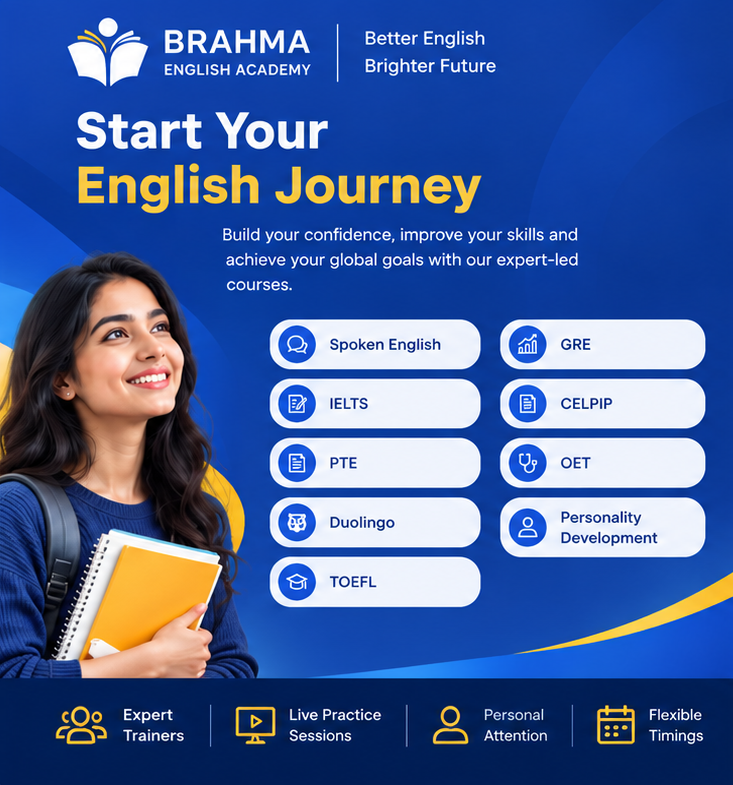
Brahma English Academy runs IELTS coaching in Pune with learners joining from Kothrud, Katraj, Kondhwa, Dhayari, Nanded City, Karve Nagar, Vadgaon Budruk, Balaji Nagar, Baner, Gokhale Nagar, Bhosari, Moshi and across Pimpri-Chinchwad. Batches are capped at 15, mock tests run weekly, and every Writing submission comes back with written feedback. Alongside IELTS, the academy offers spoken English classes in Pune, PTE, OET, Duolingo, CELPIP, TOEFL, GRE and Personality Development — useful when a learner finds mid-preparation that PTE or Duolingo suits their profile better.
Lead trainer Madhav More and the Brahma team work extensively with Marathi and Hindi-medium learners — precisely the background most Maharashtra IELTS candidates come from. Online and offline batches run morning, evening and weekend.
Before enrolling anywhere, run your scores through the [Internal Link: IELTS Band Calculator] to see which module is pulling your band down. Still deciding between exams? Compare formats on the [Internal Link: PTE Classes] page. If Speaking is the weak link, the [Internal Link: Spoken English Course] page explains the foundation track.
You do not need another banner promising bands. You need one honest diagnostic test and a trainer who tells you where you stand.
If you are comparing the best IELTS classes in Maharashtra, start with a free demo class at Brahma English Academy in Pune. Small batches, weekly mock tests, daily speaking practice and personalized feedback—plus a certificate of completion.
Call or WhatsApp: 8484819557
Visit: www.brahmaenglishacademy.com
Your intake deadline is fixed. Your band score is not. Start this week.

The best IELTS classes in Maharashtra for beginners are those that build spoken English fluency before exam technique. Look for a foundation track with daily speaking practice, small batches and a diagnostic test at enrolment, since learners below Band 5.5 need language building before test strategy.
Most learners at Band 6.0 reach Band 7.0 in 8 to 12 weeks with structured coaching and about 90 minutes of daily practice. Writing improves slowest because it needs repeated essay correction against the official band descriptors, so start Task 2 practice in week one.
Coaching is necessary if you are below Band 6.5 and need 7.0 or higher, because Speaking and Writing cannot be self-assessed accurately. Self-study works well for learners already at Band 7.0 who only need familiarity with the test format and timing discipline.
For Canada Express Entry, CLB 9 requires IELTS General Training scores of 8.0 in Listening and 7.0 each in Reading, Writing and Speaking. Language proficiency is worth up to 136 CRS points for a single applicant, making it one of the highest-impact factors in your profile.
Choose IELTS if you are comfortable with a human examiner and paper-style tasks, and PTE if you prefer computer-based scoring with faster results. Both are accepted by the Australian Department of Home Affairs, where 7.0 in each IELTS module earns 10 points and 8.0 in each earns 20 points.
Get expert guidance, personalized study plans, and real exam strategies
to crack IELTS, PTE, TOEFL & more with confidence
IELTS Coaching classes in Pune
IELTS Classes in Pune
IELTS Training center in Pune
IELTS coaching classes in Balaji Nagar, Pune
IELTS coaching classes in Katraj, Pune
IELTS coaching classes in Ambegaon Budruk, Dattanagar, Pune
IELTS coaching classes in Kondhwa, Pune
IELTS Coaching classes in Karve Nagar , Pune
IELTS coaching classes in Nanded City, Pune
IELTS coaching classes in Baner, Pune
IELTS coaching classes in Viman Nagar, Pune
IELTS coaching classes in Wadgaon Sheri, Pune
IELTS coaching classes in Gokhale Nagar, SB Road, Pune
IELTS coaching classes in Deccan, FC Road, Pune
Email
info@bramhaenglishacademy.com
Phone
8484819557 | 8485829557
8485859557 | 8485819557
8484829557 | 8412919557
9119443775


