




7.5

Expert Trainers

Proven Strategies

High Success Rate
 Proud Moment!
7.5

8.0

8.0

6.5

7.0
you can be next!

Trusted by 1000+ Students


Book IELTS Academic if your score goes to a university or a professional licensing body. Book IELTS General Training if your score goes to an immigration department—Canada PR, Australian skilled migration, or a UK work and settlement visa. Listening and speaking are identical in both. Only Reading and Writing Task 1 changes.
Every month, a few learners walk into a demo class having already paid for the wrong test. One was a data analyst from NRI Complex, Seawoods—sharp English, confident on calls, targeting Canada PR. He had booked IELTS Academic because a friend called it “the standard one.” IRCC does not accept academic for Express Entry. He lost a slot, a fee, and six weeks. That mistake is why anyone comparing the best online IELTS classes in Seawoods, Mumbai should settle one question first: academic or general training? This guide answers it with the rules that actually apply in 2026.
IELTS Academic and General Training share two of four modules. Listening and speaking are word-for-word the same. Reading and writing differ: Academic uses journal-style passages and data-description tasks; general training uses workplace notices, handbooks and a letter. Both run on the same 0–9 band scale and the same 2 hours 45 minutes.
The British Council states the position plainly: choose Academic if you plan to study at university; choose General Training if you plan to work or migrate abroad. Both assess the same four skills—only the reading and writing tasks change.
The breakdown we put on the whiteboard in week one:
| Feature | IELTS Academic | IELTS General Training |
|---|---|---|
| Main purpose | University admission (UG/PG), professional registration | PR, skilled migration, work visas, below-degree study |
| Listening | Identical—30 minutes, 40 questions | Identical—30 minutes, 40 questions |
| Speaking | Identical—3 parts, face-to-face examiner | Identical—3 parts, face-to-face examiner |
| Reading source texts | Books, journals, research-style articles | Notices, advertisements, company handbooks, workplace documents |
| Writing Task 1 | Describe a graph, table, chart, map, or process | Write a letter (formal, semi-formal, or personal) |
| Writing Task 2 | Formal academic essay, 250+ words | Essay on a general topic, slightly less formal register |
| Band 7 Reading (raw) | Around 30–32 correct out of 40 | Around 34–35 correct out of 40 |
| Accepted for Canada PR | No | Yes. |
| Accepted by universities | Yes. | Usually not for degree-level entry |
That last row is where the damage happens. Per IRCC guidance, academic results are not accepted for an Express Entry profile—take Academic by mistake, and you sit General Training again, from scratch.
Book the test your receiving organization demands. Seawoods learners applying to universities in the UK, Australia, Canada, or the USA need IELTS Academic. Those filing Canada Express Entry, Australian skilled migration, or a UK work visa need general training. Nurses and doctors registering with NMC or AHPRA need academic training even though they are migrating, not studying.
Look at the profile mix around Seawoods Darave, and the confusion makes sense. On one train: a final-year student from Nerul chasing a September intake in Manchester, an IT professional from Palm Beach Road commuting to Airoli on a Canada PR file, and a nurse from Sanpada preparing for AHPRA. Same station, three different tests.
Three questions to settle before you pay:
If two answers point different ways, you sit both tests—study in Canada on academic and apply for PR later on for general training. Any trainer worth counting among the best online IELTS classes in Seawoods, Mumbai maps that sequence with you on the counselling call before a single class begins.
General training is not easier—it is scored more strictly to compensate. The texts are simpler, so the raw-score bar rises. Band 7 in Academic Reading typically needs 30–32 correct answers out of 40, while General Training Reading needs roughly 34–35. You get less room for error, not more.
This is the biggest misconception we correct in class. A learner from Kharghar felt “safe” on general training. He was scoring 31/40 in mock reading—a comfortable Band 7 on academic, but only Band 6.5 on General Training. Two questions stood between him and CLB 9.
Writing brings its own trap. General Training Task 1 is a letter, and Indian test-takers routinely lose marks on tone — an over-formal complaint to a friend or a casual opening in a formal request. Marathi and Hindi speakers also carry direct-translation habits into Task 2: “I agree,” “discuss about,” and “one of my friends.” Three to four weeks of corrected drafts fix these, which is why the best online IELTS classes in Seawoods, Mumbai mark Writing individually every week. Self-study cannot. IELTS Band Calculator
The best online IELTS classes in Seawoods, Mumbai are the ones that split academic and general training preparation instead of teaching one generic syllabus. Look for module-specific Reading and writing training, weekly full-length mocks, examiner-style Speaking practice, and batches small enough for individually marked writing.
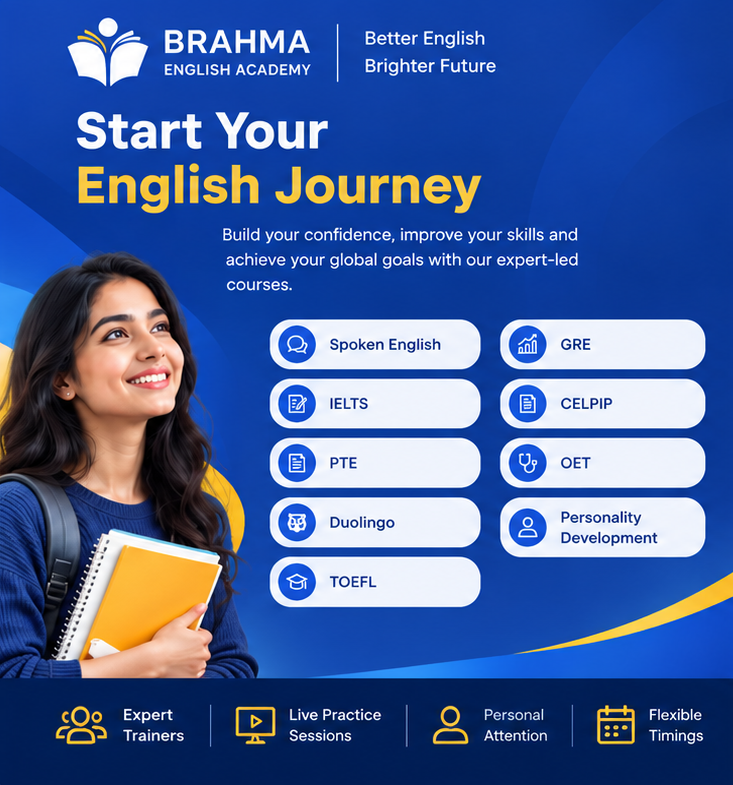
Brahma English Academy runs live online IELTS coaching for Seawoods, Nerul, Belapur, and Kharghar learners from its Pune base—no travel to a centre, no recorded-video shortcuts. Batches are capped at 15 students, so everyone speaks daily. Led by Madhav More and the Brahma training team, Academic and General Training run as separate tracks, alongside PTE, OET, CELPIP, TOEFL, Duolingo, and Spoken English.
What a batch actually includes:
Structured coaching beats self-study for one unglamorous reason: nobody can mark their own writing. You cannot see your own coherence gaps, your repeated linkers, or the four collocation errors quietly capping you at Band 6.5. An examiner-trained reader spots all of it in ten minutes—and that is the whole distance between 6.5 and 7.5. Courses page
Most learners starting at Band 5.5–6.0 reach a Band 7 target in 8 to 12 weeks with structured coaching and daily practice. General training candidates usually need slightly less time because there is no data-description task to master. Below Band 5.0, plan 16 weeks starting with a spoken-fluency foundation.
Here is the roadmap. Seawoods learners follow in our batches:
| Phase | Weeks | Focus | Milestone |
|---|---|---|---|
| Diagnostic | Week 1 | Full mock, test-type confirmation, band gap analysis | Correct test booked |
| Foundation | Weeks 2–4 | Grammar accuracy, mother-tongue interference, listening accents | Fluency without hesitation |
| Module drills | Weeks 5–8 | Academic charts or GT letters; Reading question types | Consistent target band in 2 modules |
| Exam simulation | Weeks 9–11 | Weekly full-length mocks, timed Reading transfer | Target band in all 4 modules |
| Final polish | Week 12 | Speaking Part 3 depth, writing band-descriptor checks | Test day booked with confidence |
Two timing facts worth planning around. IDP Education has discontinued paper-based IELTS across India—from September 2026, every test in the country is computer-delivered, which makes typing speed and on-screen reading real preparation variables. And results stay valid for two years, so a score taken too early can expire before your ITA or admission offer lands.
Choosing between IELTS Academic and General Training is a five-minute conversation that saves six weeks of wrong preparation. Have it before you book your slot.
If you are comparing the best online IELTS classes in Seawoods, Mumbai, start with a free demo class at Brahma English Academy—sit in a live session, take a diagnostic mock, and get a straight answer on which test your goal requires.
📞 Call or WhatsApp: 8484819557
🌐 Visit: www.brahmaenglishacademy.com

You need IELTS General Training for Canada PR through Express Entry. IRCC does not accept IELTS Academic for immigration applications. The Federal Skilled Worker minimum is CLB 7 — Band 6.0 in each of the four modules—and your result must be under two years old when you submit.
Yes, you can take both, and many candidates do. Each test needs its own registration and test date. This is common for learners who study abroad on an Academic score and later apply for permanent residency, which requires General Training.
No, General Training is not easier overall. Its passages are simpler in language, but the raw-score conversion is stricter — Band 7 needs roughly 34–35 correct out of 40 in General Training Reading, versus 30–32 in Academic.
No, Listening and Speaking are exactly the same in both versions — same recordings, same question types, same three-part face-to-face interview, same band descriptors. Only Reading and Writing Task 1 differ.
For degree-level study in the UK you need IELTS Academic, usually the IELTS for UKVI Academic version if your university requires a SELT. For courses below degree level, or for work and settlement visas, the UK requires IELTS for UKVI General Training. Confirm the version named on your CAS.
Get expert guidance, personalized study plans, and real exam strategies
to crack IELTS, PTE, TOEFL & more with confidence
IELTS Coaching classes in Pune
IELTS Classes in Pune
IELTS Training center in Pune
IELTS coaching classes in Balaji Nagar, Pune
IELTS coaching classes in Katraj, Pune
IELTS coaching classes in Ambegaon Budruk, Dattanagar, Pune
IELTS coaching classes in Kondhwa, Pune
IELTS Coaching classes in Karve Nagar , Pune
IELTS coaching classes in Nanded City, Pune
IELTS coaching classes in Baner, Pune
IELTS coaching classes in Viman Nagar, Pune
IELTS coaching classes in Wadgaon Sheri, Pune
IELTS coaching classes in Gokhale Nagar, SB Road, Pune
IELTS coaching classes in Deccan, FC Road, Pune
Email
info@bramhaenglishacademy.com
Phone
8484819557 | 8485829557
8485859557 | 8485819557
8484829557 | 8412919557
9119443775


