




7.5

Expert Trainers

Proven Strategies

High Success Rate
 Proud Moment!
7.5

8.0

8.0

6.5

7.0
you can be next!

Trusted by 1000+ Students

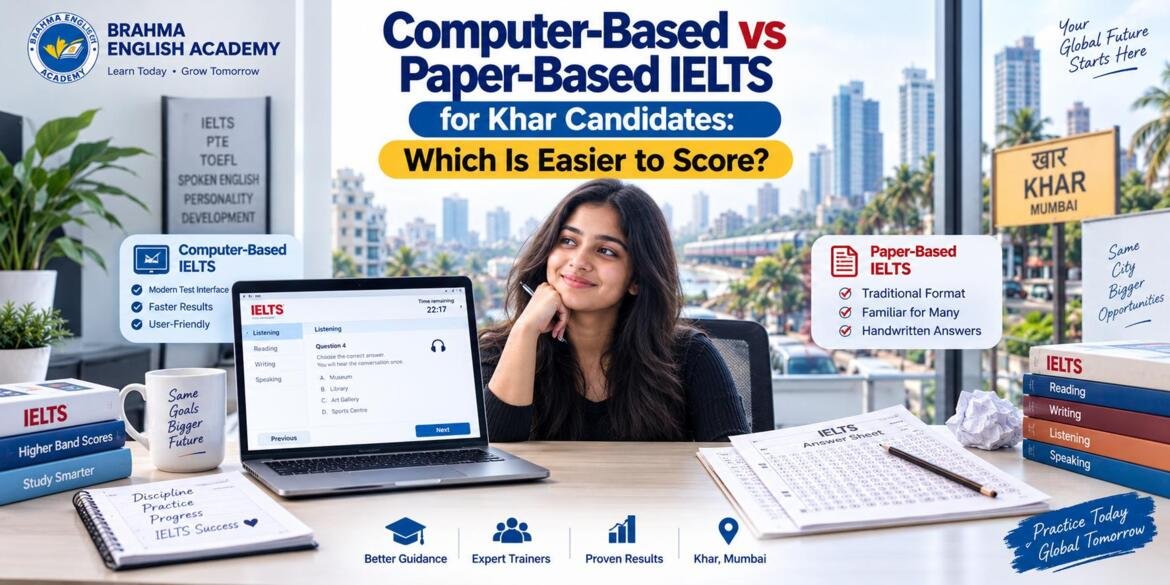
If you are still deciding between computer-based and paper-based IELTS, there is something you need to know before you book anything. The choice no longer exists in India.
That single fact changes how every Khar candidate should prepare. If you are searching for the best online IELTS classes in Khar, Mumbai, the first question to ask any coaching centre is whether they still teach old paper strategies — because plenty do. Media professional off Linking Road targeting a UK master’s, or chartered accountant near Khar Road station working towards Canadian PR: the format you train in decides how you feel on test day.
Neither format is easier — the IELTS partners confirm scores are comparable across delivery modes, both overall and within each band. Since September 2026, paper-based IELTS is no longer offered in India. Khar candidates now choose between IELTS on Computer or IELTS on Computer with Writing on Paper. Difficulty, questions and band descriptors stay identical.
No. Paper-based IELTS is no longer available anywhere in India. IDP Education announced in July 2026 that the last three paper sessions would run on 25 July, 6 August and 22 August 2026, and that from September 2026 all IELTS tests in India would be computer-delivered. Existing paper results stay valid for two years.
This follows a global decision: the IELTS partners announced in March 2026 that IELTS would no longer be offered as a paper-based test from mid-2026, with timelines varying by market.
So if a friend in Santacruz or Bandra tells you paper is “easier for handwriting people”, that advice is two formats out of date.
What did not change: the skills assessed, the test construct, and how institutions read your result. Same nine-band scale. Same four modules. Same examiners.
Khar candidates now choose between two computer-delivered options. In standard IELTS on Computer, Listening, Reading and Writing are all completed on screen. In IELTS on Computer with Writing on Paper, Listening and Reading stay on screen while you handwrite Writing. Speaking stays face-to-face in both.
| Feature | IELTS on Computer | IELTS on Computer (Writing on Paper) | Old Paper Test |
|---|---|---|---|
| Availability in India | Yes | Yes, from 1 September 2026 | Discontinued after August 2026 |
| Listening & Reading | On screen | On screen | Was on paper |
| Writing Task 1 & 2 | Typed | Handwritten | Was handwritten |
| Speaking | Face-to-face with examiner | Face-to-face with examiner | Face-to-face |
| Word count | Counted automatically | You estimate it yourself | Manual |
| Best suited to | Comfortable typists | Slow typists, heavy planners | — |
| Test date availability | High | Selected centres and dates | — |
Two details most candidates miss. One Skill Retake must be taken in the same delivery mode as the original test — pick Writing on Paper, and your retake is locked to it. And the Secure English Language Test for UK Visas and Immigration is fully digital only, so UK SELT applicants may not get the handwriting option.
Choose standard IELTS on Computer if you type at a reasonable pace and think while you type. Choose Writing on Paper if you plan essays by hand, cross out and restructure, or type slowly enough that Task 2 becomes a race. Test both in mock conditions before booking — most candidates discover their real preference within two practice essays.
Take a marketing executive in Khar West — strong English, confident speaker, targeting Band 7. Her first typed Task 2 came in at 218 words because she kept deleting and rewriting. Same essay handwritten: 271 words, clearer argument. Writing on Paper was obviously her format.
Now compare an IT professional from Powai chasing Canadian PR. He types 45 words a minute and edits fluidly on screen. Typed Writing was clearly his route — no legibility risk, no word-count guessing.
Different people. Different formats. Same band target.
This is why good coaching runs diagnostic mocks in both modes before telling you what to book.
What changes in your preparation strategy on computer?
Screen delivery changes timing and technique in every module except Speaking. Listening loses the ten-minute transfer window, Reading loses pencil annotation, Writing gains an automatic word counter. None of it makes the test harder — but preparing with paper habits and testing on screen does cost bands.
What our trainers drill, module by module:
“`
“`
For a Marathi-medium graduate from Dadar or a Hindi-medium candidate in Khar East, that last point matters far more than the format debate.
Because the commute is the real enemy of consistency. A Khar candidate travelling to Andheri or Dadar for evening classes loses eight to ten hours a week to Western Line traffic — hours that should go into Reading practice. The best online IELTS classes in Khar, Mumbai remove that loss entirely.
Brahma English Academy runs fully online IELTS coaching from Pune, serving candidates across Khar, Bandra, Santacruz, Juhu, Vile Parle, Andheri, Dadar, Powai and Thane. There is no physical branch in Mumbai — deliberately. Live batches capped at 15 students give every candidate speaking time in every session, which a 40-student offline hall cannot.
What that looks like in practice:
Madhav More and the Brahma training team coach IELTS, PTE, OET, TOEFL, CELPIP and Duolingo — so format advice comes from someone who knows what a Band 6.5 Writing script looks like next to a Band 7.
Check your practice scores anytime with the free IELTS Band Calculator.
| Weeks | Focus | Outcome |
|---|---|---|
| Week 1–2 | Diagnostic mock in both formats, band descriptor training | Format decision locked |
| Week 3–4 | Listening spelling accuracy, on-screen Reading tools, Task 1 structures | Reading time under control |
| Week 5–6 | Task 2 argument planning, Speaking Part 3 depth, pronunciation correction | Writing and Speaking stabilise |
| Week 7 | Two full-length timed mocks, error log review | Test-day pacing fixed |
| Week 8 | Final mock, One Skill Retake planning if needed | Booking confidence |
Most working professionals in Mumbai reach their target band within eight to twelve weeks of structured daily practice. Self-study candidates stall at Band 6 to 6.5 — not from weak English, but from unexamined Writing structure and untracked Speaking errors. Nobody spots their own hesitation pattern; a trainer does, in week two. That feedback loop separates the best online IELTS classes in Khar, Mumbai from a YouTube playlist.
The format debate is settled. Your preparation strategy is the only variable left — and that is where bands are won today.
If you want the best online IELTS classes in Khar, Mumbai, start with a conversation, not a payment. Book your free demo class with Brahma English Academy today. Sit in a live batch, take a computer-format diagnostic, and see exactly where your four modules stand.
📞 Call or WhatsApp: 8484819557
🌐 Visit: www.brahmaenglishacademy.com

Neither format is easier, because the IELTS partners confirm scores are comparable across delivery modes both overall and within each band. Content, question types and band descriptors are identical — only the input method changes, so choose based on typing comfort rather than an expected scoring advantage.
No, paper-based IELTS is no longer available anywhere in India. IDP Education confirmed the final paper dates as 25 July, 6 August and 22 August 2026. From September 2026 all IELTS tests in India are computer-delivered, with an optional Writing on Paper format at selected centres.
IELTS Writing on Paper is a computer-delivered test where you handwrite only the Writing section while Listening and Reading stay on screen. It became available in India from 1 September 2026. Speaking remains face-to-face, and the scoring criteria are unchanged.
No, the ten-minute transfer time applied only to the paper-based test. On computer-delivered IELTS you type answers directly into the response boxes and get a short review window at the end, which makes live spelling accuracy far more important.
No, IELTS Speaking remains a face-to-face conversation with a certified IELTS examiner in both computer-delivered options. The three-part structure, timing and assessment criteria are unchanged — only Listening, Reading and Writing are affected.
Get expert guidance, personalized study plans, and real exam strategies
to crack IELTS, PTE, TOEFL & more with confidence
IELTS Coaching classes in Pune
IELTS Classes in Pune
IELTS Training center in Pune
IELTS coaching classes in Balaji Nagar, Pune
IELTS coaching classes in Katraj, Pune
IELTS coaching classes in Ambegaon Budruk, Dattanagar, Pune
IELTS coaching classes in Kondhwa, Pune
IELTS Coaching classes in Karve Nagar , Pune
IELTS coaching classes in Nanded City, Pune
IELTS coaching classes in Baner, Pune
IELTS coaching classes in Viman Nagar, Pune
IELTS coaching classes in Wadgaon Sheri, Pune
IELTS coaching classes in Gokhale Nagar, SB Road, Pune
IELTS coaching classes in Deccan, FC Road, Pune
Email
info@bramhaenglishacademy.com
Phone
8484819557 | 8485829557
8485859557 | 8485819557
8484829557 | 8412919557
9119443775


