




7.5

Expert Trainers

Proven Strategies

High Success Rate
 Proud Moment!
7.5

8.0

8.0

6.5

7.0
you can be next!

Trusted by 1000+ Students

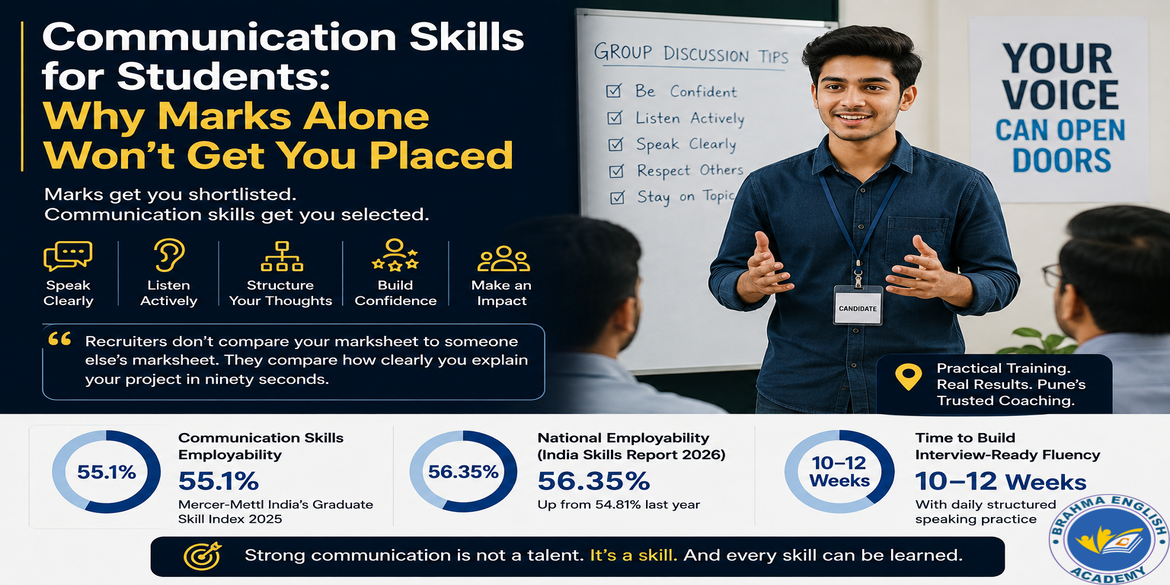
Every placement season, I meet a student in Pune who is genuinely brilliant on paper—8.6 CGPA, three certifications, a solid final-year project—and who still walks out of the group discussion round without saying a single sentence. That gap is exactly why communication skills for students have become the deciding factor in campus placements, not a “nice to have.” Recruiters are not comparing your marksheet to someone else’s marksheet. They are comparing how clearly you explain your project in ninety seconds. This blog breaks down what companies actually test, why Marathi and Hindi-medium learners struggle in that specific moment, and the realistic timeline to fix it.
Communication skills for students are the ability to speak, listen, and present ideas clearly in professional settings—and they now decide placements more than marks do. Recruiters use group discussions, HR rounds, and presentations to test clarity, confidence, and structure. Most students build interview-ready fluency in 10–12 weeks of daily structured speaking practice.
Students with great marks fail interviews because exams test written recall while placements test spoken performance under time pressure. A marksheet proves you understood the syllabus. A group discussion proves you can think aloud, disagree politely, and hold a room. Colleges rarely grade the second skill, so most graduates never practise it.
Look at the numbers. According to the India Skills Report 2026—the 13th edition, released by ETS with CII, AICTE, AIU, and Taggd—national employability rose to 56.35%, up from 54.81% the previous year. Encouraging, yes. But Mercer-Mettl’s India’s Graduate Skill Index 2025 found only 42.6% of Indian graduates employable, down from 44.3% in 2023, with non-technical abilities such as communication, problem-solving, and creativity lagging behind technical skills. Translation: the technical pipeline is improving faster than the speaking pipeline.
Take Omkar, a composite of learners I have trained. Mechanical engineering degree, working at a supplier unit in Bhosari MIDC, excellent at CAD and process troubleshooting. In client calls he answers in three words and lets his manager finish his sentences. His technical value never leaves his head. That is not an intelligence problem—it is a rehearsal problem.
Recruiters test five things: clarity of speech, structure of thought, active listening, confident body language, and the ability to answer follow-up questions without freezing. They assess these skills in group discussions, HR interviews, technical explanations, and short presentations. Grammar perfection matters far less than being understood on the first attempt.
Here is what each round is really measuring:
Marathi and Hindi-medium learners share a very predictable set of errors, and predictable errors are the easiest to fix:
None of these signal low intelligence. They signal low exposure. Rutuja, a Marathi-medium BSc graduate from Dhayari who joined one of our morning batches, made every mistake on this list in week one. By week seven she was moderating group discussions. Her vocabulary barely changed. Her retrieval speed changed.
Most students reach interview-ready fluency in 10–12 weeks of structured daily practice, with noticeable confidence gains in the first 3–4 weeks. The timeline depends on daily speaking minutes, not on years of English study. Students who speak for 30 focused minutes a day progress roughly three times faster than students who only revise grammar rules.
| Phase | Weeks | What You Work On | What Changes |
|---|---|---|---|
| Foundation | 1–3 | Sentence formation, present/past tenses, self-introduction | You stop translating mid-sentence. |
| Fluency | 4–6 | Daily speaking drills, storytelling, opinion practice | Hesitation drops sharply. |
| Pressure | 7–9 | Group discussions, debates, role plays | You can think and speak simultaneously. |
| Polish | 10–12 | Mock interviews, presentations, pronunciation refinement | You sound placement-ready. |
Notice that pronunciation polish comes last. Students who chase a perfect accent in week one usually stay silent for three months. Fluency first, accuracy next, polish at the end—that sequence works.
Structured coaching wins because it supplies the two things self-study cannot: a live audience and corrective feedback. You can learn 500 words alone. You cannot learn to handle an interruption, a follow-up question, or a hostile panel without real people in the room.
| Factor | Self-Study (Apps, YouTube) | College Soft-Skills Workshop | Structured Coaching |
|---|---|---|---|
| Daily speaking practice | Rare — mostly passive | 2–3 sessions per semester | Every single class |
| Error correction | None | Generic, group-level | Individual, same-day |
| Pressure simulation | Zero | Occasional | GDs, debates, mock interviews |
| Accountability | Depends on motivation | Low | Attendance + batch peers |
| Typical time to visible change | 6–12 months | Minimal | 10–12 weeks |
Self-study is excellent for input—reading, listening, and vocabulary. It fails at output. Output needs witnesses.
Brahma English Academy runs spoken English classes in Pune built specifically around output. Batches are capped at 15 students so every learner speaks in every session—not once a week, every session. The Personality Development track layers on body language, eye contact, and structured answer frameworks, while our IELTS coaching in Pune, PTE, OET, Duolingo, CELPIP, TOEFL, and GRE programs serve students whose communication goals extend to studying abroad.
Our trainers, led by Madhav More, work with learners from Kothrud, Baner, Katraj, Kondhwa, Dhayari, Nanded City, Karve Nagar, Vadgaon Budruk, Bhosari, Moshi, and across Pimpri-Chinchwad. Many arrive from Marathi or Hindi-medium backgrounds, carrying years of “I know English, but I can’t speak it.” That is a training problem, not a talent problem.
Every batch runs on the same rhythm: daily speaking practice, group discussions, role plays, debates, mock interviews, and personalised feedback. Morning, evening, and weekend batches run online and offline, with a certificate of completion. Study-abroad aspirants can benchmark themselves using our free [Internal Link: IELTS Band Calculator] and [Internal Link: PTE Score Calculator].
One more thing worth saying plainly. The India Skills Report 2022 named Pune the city with the highest pool of highly employable talent, with 78% of candidates scoring above 60%. You are competing inside a very strong talent pool. Marks alone will not separate you from it. Communication does.
If you have the marks but freeze the moment someone says “tell me about yourself,” that is a trainable gap—and twelve weeks is usually all it takes. Building strong communication skills for students is the highest-return investment you can make before placement season starts.
Book your free demo class with Brahma English Academy today.
📞 Call or WhatsApp: 8484819557
🌐 www.brahmaenglishacademy.com
Small batches. Daily speaking practice. Real mock interviews. Morning, evening, and weekend options, online and offline.

Communication skills for students matter more than marks because every placement round after shortlisting is spoken, not written. Companies use marks to filter applications, then use group discussions and interviews to select. Two candidates with identical CGPAs are separated entirely by how clearly they explain their thinking.
A Marathi-medium student improves fastest by speaking daily in a corrected environment rather than studying grammar silently. Focus on sentence formation, common translation errors like "since 3 years," and v/w pronunciation. Most learners see clear improvement within 4–6 weeks of structured daily speaking practice.
Most students reach interview-ready fluency in 10–12 weeks of structured practice. Confidence usually improves within the first month, hesitation drops by week six, and mock-interview performance stabilises by week ten. Learners practising only occasionally typically need six months or more.
You can improve vocabulary and listening alone, but not interview performance. Self-study cannot simulate interruptions, follow-up questions, or panel pressure, and it provides no error correction. Structured batches with group discussions and mock interviews close that gap far faster.
Yes — strong communication skills directly improve IELTS Speaking, PTE Speaking and Writing, and visa interviews. Fluency, pronunciation clarity and structured answers are scored in every major test. Students targeting IELTS 7+, PTE 65–79 or CELPIP CLB 9 benefit from the same daily speaking foundation.
Get expert guidance, personalized study plans, and real exam strategies
to crack IELTS, PTE, TOEFL & more with confidence
IELTS Coaching classes in Pune
IELTS Classes in Pune
IELTS Training center in Pune
IELTS coaching classes in Balaji Nagar, Pune
IELTS coaching classes in Katraj, Pune
IELTS coaching classes in Ambegaon Budruk, Dattanagar, Pune
IELTS coaching classes in Kondhwa, Pune
IELTS Coaching classes in Karve Nagar , Pune
IELTS coaching classes in Nanded City, Pune
IELTS coaching classes in Baner, Pune
IELTS coaching classes in Viman Nagar, Pune
IELTS coaching classes in Wadgaon Sheri, Pune
IELTS coaching classes in Gokhale Nagar, SB Road, Pune
IELTS coaching classes in Deccan, FC Road, Pune
Email
info@bramhaenglishacademy.com
Phone
8484819557 | 8485829557
8485859557 | 8485819557
8484829557 | 8412919557
9119443775


