



7.5

Expert Trainers

Proven Strategies

High Success Rate
 Proud Moment!
7.5

8.0

8.0

6.5

7.0
you can be next!

Trusted by 1000+ Students

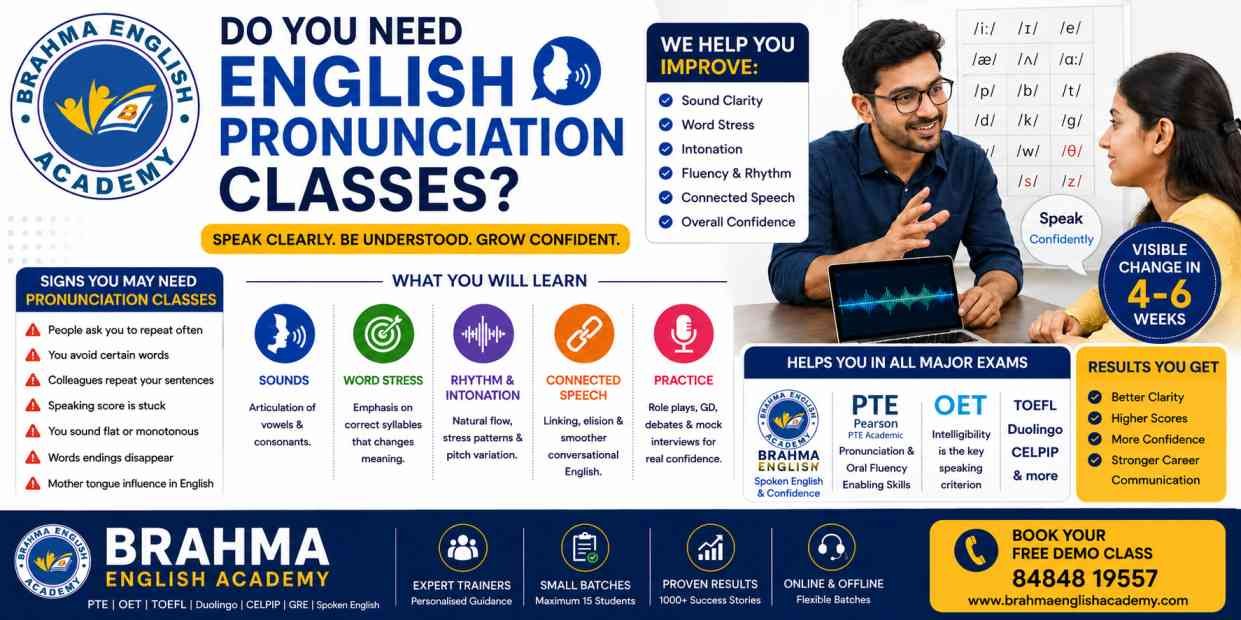
Wondering if you need English pronunciation classes? Spot the 7 warning signs, learn what these classes teach, and fix mother-tongue influence in Pune.
You need pronunciation training if listeners misunderstand you despite correct grammar, if you avoid certain words on purpose, if colleagues repeat your sentences back “correctly,” or if your test speaking score plateaus below your target. Two or more of these signs mean your pronunciation — not your English knowledge — is the bottleneck.
Watch for these seven signals:
Take Rohit — a mechanical engineer from Bhosari MIDC, brilliant on tolerances, invisible on client calls. In a quality review with a German client, he said “vibration” four times. Nobody questioned his engineering; they simply stopped asking him questions. Rohit assumed his English was weak. It wasn’t. One sound was made.
Or Sneha, a nurse from Dhayari preparing for OET ahead of her NMC UK registration. Warm, confident clinical communication — held back by intelligibility, because her final consonants dropped and her stress landed wrong in words like “diaBEtes” and “aBDOmen.”
Different learners, same root cause. Both fixed within a term.
Good English pronunciation classes teach four layers: individual sounds, word stress, sentence rhythm and intonation, and connected speech. You practice with minimal pairs, mirror work, recording, and shadowing, then apply everything under pressure in role plays, group discussions, and mock interviews until clarity becomes automatic.
Here’s what a serious syllabus covers:
The OET Speaking assessment criteria glossary lists intelligibility as the first linguistic criterion: clear final consonants and vowels, correct word stress, no mumbling, and natural sentence rhythm. That’s a pronunciation syllabus written by an exam board.
Structured classes work fastest because they give you what YouTube and apps cannot: a trained ear correcting you in real time. Self-study builds awareness. Apps build consistency. Only a live trainer catches the error you don’t know you’re making — and that error is usually the one costing you marks.
| Factor | YouTube / Self-Study | Pronunciation Apps | Structured Classes in Pune |
|---|---|---|---|
| Diagnosis of your errors | None — you guess | Generic, algorithmic | Personal audit in week one |
| Real-time correction | No | Delayed, scripted | Immediate, every session |
| Mother-tongue influence work | Rarely addressed | Not localised | Built for Marathi/Hindi speakers |
| Pressure practice | None | Solo only | GDs, debates, mock interviews |
| Exam alignment | Random | Limited | Mapped to IELTS, PTE, OET criteria |
| Typical visible change | 6+ months, often plateaus | 3–4 months | 4–6 weeks |
| Accountability | Fully self-driven | Streaks and reminders | Trainer + batch + weekly review |
Free resources are excellent for exposure. They’re poor at correction. Most learners who arrive at our Kothrud and Karve Nagar batches have already watched dozens of accent videos — and still repeat the same six errors because nobody ever told them those six errors existed.
Most learners notice clearer speech within 4–6 weeks of daily guided practice and reset habitual errors in roughly 12 weeks. Sound-level corrections move fastest. Rhythm and intonation take longer because they’re deeply wired to your first language. Consistency matters more than class hours.
Here’s the roadmap we follow:
| Timeline | Focus | What Happens |
|---|---|---|
| Weeks 1–2 | Diagnosis | Recorded baseline, error mapping, and a shortlist of your five highest-impact sounds |
| Weeks 3–6 | Sound correction | Minimal pairs, mirror work, tongue placement, daily 15-minute drills — this is where the “come again?” moments start disappearing |
| Weeks 7–10 | Stress and rhythm | Word stress patterns, sentence stress, weak forms, and intonation contours — your English starts sounding smooth, not just correct |
| Weeks 11–12 | Pressure application | Role plays, debates, presentations, mock interviews, and full-length mock tests — clarity becomes reflexive |
An IT professional from Wadgaonsheri targeting PTE 79 for Australia PR is typical: his pronunciation-enabling score dragged speaking down while reading sat high. Nine weeks of read-aloud and repeat-sentence drilling, plus stress-pattern work, changed the score report — not his accent.
Curious where you currently stand? Run your practice results through our free PTE Score Calculator before you book a real test date.
Brahma English Academy runs pronunciation-focused spoken English classes in Pune alongside IELTS coaching, PTE, OET, Duolingo, CELPIP, TOEFL, GRE, and personality development programs. Learners from Kothrud, Katraj, Bhosari, Kondhwa, Nanded City, Balaji Nagar, Baner and Pimpri-Chinchwad train in the same room — real accent variety, real listening practice.
What makes the difference in our batches:
Madhav More and the Brahma training team have spent years working specifically with Marathi- and Hindi-medium learners, which is why the diagnosis is fast: we’ve heard your exact error pattern hundreds of times before.
If your goal is everyday confidence, pair pronunciation work with our Spoken English Course. If you’re testing soon,
our IELTS Classes fold pronunciation directly into speaking practice — sensible, given that IELTS scores pronunciation as one of four equally weighted criteria, each worth 25% of the speaking band.
You don’t need a foreign accent. You need clear sounds, correct stress, and someone who tells you the truth about how you sound.
Book your free demo class with Brahma English Academy and get a recorded pronunciation audit in your first session — your five priority sounds, mapped and explained. Small batches, daily speaking practice, morning, evening, and weekend timings, online and offline.
📞 Call or WhatsApp: 8484819557
🌐 Website: brahmaenglishacademy.com
Your voice already has the ideas. Let’s make sure everyone hears them.

No — you do not need to lose your Indian accent. IELTS and PTE assess how clearly you can be understood, not which accent you have. A clear Indian accent with accurate stress and intonation scores well. Unclear sounds, dropped word endings and flat rhythm are what cost marks.
Fees vary by course length, batch type and mode. Brahma English Academy runs morning, evening and weekend batches online and offline, with a free demo class so you can judge the trainer before paying. Call or WhatsApp 8484819557 for current fees.
You can improve, but progress is slower and usually plateaus. Self-study builds awareness; it rarely builds accuracy, because you cannot hear the errors you are used to making. A trained ear turns temporary improvement into permanent habit.
The most common are v/w confusion, th replaced by t or d, s/sh mixing, z pronounced as j, retroflex t and d, an added vowel before words like school and station, and dropped final consonants. Word stress errors cause the most misunderstanding.
Yes, when they are live, small-batch and feedback-driven. Headphone audio actually makes individual sounds easier to isolate. Recorded courses without live correction are far less effective, whatever the format.
Get expert guidance, personalized study plans, and real exam strategies
to crack IELTS, PTE, TOEFL & more with confidence
IELTS Coaching classes in Pune
IELTS Classes in Pune
IELTS Training center in Pune
IELTS coaching classes in Balaji Nagar, Pune
IELTS coaching classes in Katraj, Pune
IELTS coaching classes in Ambegaon Budruk, Dattanagar, Pune
IELTS coaching classes in Kondhwa, Pune
IELTS Coaching classes in Karve Nagar , Pune
IELTS coaching classes in Nanded City, Pune
IELTS coaching classes in Baner, Pune
IELTS coaching classes in Viman Nagar, Pune
IELTS coaching classes in Wadgaon Sheri, Pune
IELTS coaching classes in Gokhale Nagar, SB Road, Pune
IELTS coaching classes in Deccan, FC Road, Pune
Email
info@bramhaenglishacademy.com
Phone
(+91) 8484819557/ 8485829557/ 8485859557/ 8485819557/ 8484829557/ 8412919557/ 9119443775