



7.5

Expert Trainers

Proven Strategies

High Success Rate
 Proud Moment!
7.5

8.0

8.0

6.5

7.0
you can be next!

Trusted by 1000+ Students

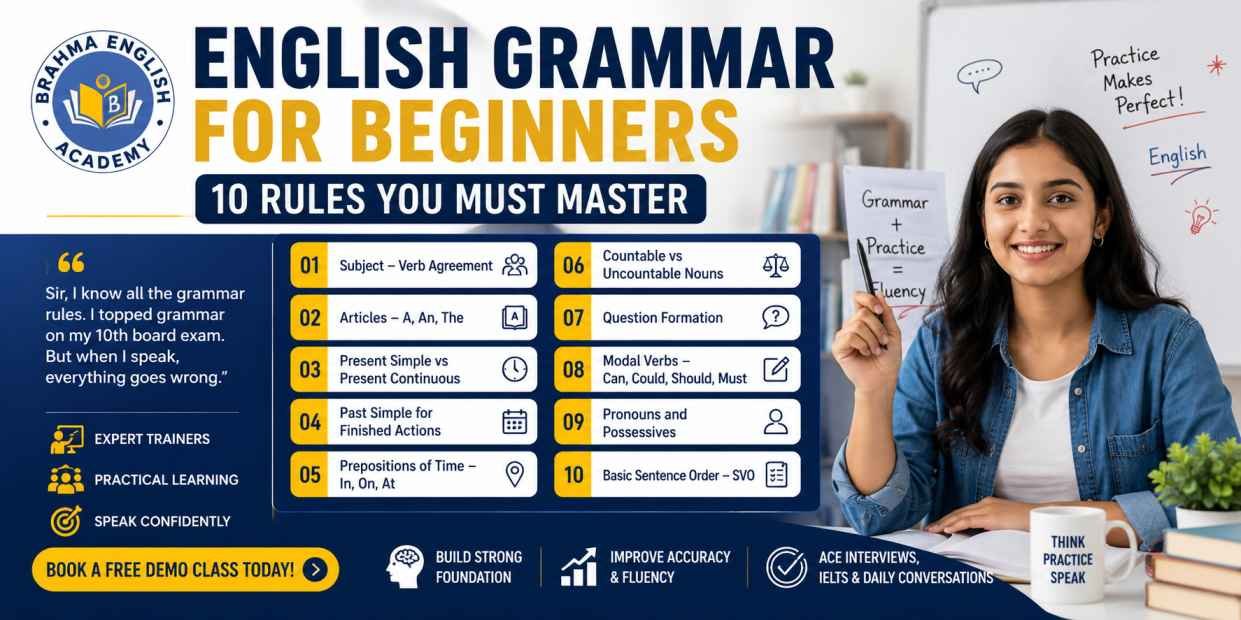
Learn English grammar for beginners with 10 simple rules our Pune trainers teach daily. Fix common Marathi/Hindi-speaker mistakes. Book a free demo class.
I hear some version of this every single week at our Kothrud centre. A commerce graduate from Karve Nagar. A QA engineer from Hinjewadi. A nurse preparing for her UK registration. Different people, same problem—and the honest truth is this: English grammar for beginners is not about memorising 200 rules from a Wren & Martin textbook. It’s about mastering the 10 rules that carry 80% of everyday English until they become automatic.
After a decade of teaching spoken English classes in Pune, I can tell you exactly which rules trip up Marathi and Hindi-medium learners — and how to fix them. That’s what this guide covers. No jargon. No exam-style theory. Just the grammar that decides whether you sound confident in a job interview, a client call, or an IELTS Speaking test.
Grammar feels hard because English works differently from Indian languages, not because you’re a weak learner. Marathi and Hindi have no articles (a, an, or the), flexible word order, and different preposition logic—so your brain naturally transfers mother-tongue patterns into English, creating predictable, fixable mistakes.
Here’s a classroom moment I see constantly: a student says, “I am going to office.” In Marathi, “मी ऑफिसला जातोय” needs no article—so the English version feels complete. It isn’t. It’s “I am going to the office.” The error isn’t carelessness; it’s linguistics. Once students understand why they make a mistake, they stop repeating it far faster.
According to the 2011 Census of India, only around 10% of Indians reported speaking English at all, and for the vast majority, it is a second or third language—which means almost every learner in our fluency classes is fighting the same mother-tongue interference, not a personal weakness.
These are the rules I drill in every beginner batch at Brahma English Academy. Master these before touching anything advanced.
One subject, one matching verb. She goes, not she go. They were, not they was. The classic Pune-classroom error: “My friend live in Deccan.” Add the -s: “My friend lives in Deccan.” Singular subject → verb takes -s in present tense.
The single biggest gap for Marathi/Hindi-medium learners.
I work in Hinjewadi (routine, permanent) vs. I am working on a new project (happening now, temporary). Mixing these—”I am knowing the answer”—is a fossil error I correct daily. Stative verbs like know, want, understand, and believe almost never take the -ing form.
If the action is over and the time is clear, use the past simple: “I completed my graduation in 2022.” Avoid the very common Indian-English pattern “I have completed my graduation in 2022″—once you mention a finished time (in 2022, yesterday, last month), present perfect is wrong.
So it’s “The interview is on Tuesday at 11 am”, not “on Tuesday”.
Advice, information, furniture, luggage, and homework are uncountable—no advices, no informations. In placement interviews, “Can you give me an advice?” instantly signals a beginner. Say “some advice” or “a piece of advice”.
English questions need an auxiliary verb and inverted order: “Where do you live?” not “Where you live?” or “You live where?” This one rule transforms how confident you sound in interviews because interviews are full of questions—both asked and answered.
Modals never change form and are never followed by to: “She can speak English” (not “can to speak” or “can speaks”). Use “could” and “would” to sound polite in professional emails and client calls: “Could you share the file?”
It’s vs. its, their vs. there, and your vs. you’re. In writing tasks—including IELTS Writing—these small slips cost marks under the Grammatical Range and Accuracy criterion. A 10-second proofread catches most of them.
English is rigid: Subject → Verb → Object. “Riya submitted the report.” Marathi allows “रियाने रिपोर्ट सबमिट केला” with the verb at the end, so beginners often build English sentences in mother-tongue order first, then translate. Practise thinking directly in SVO—it’s the foundation every other rule sits on.
A motivated beginner masters these 10 core grammar rules in 8–12 weeks with structured daily practice. At Brahma English Academy, students in our spoken English classes in Pune typically show clearly noticeable improvement—fewer article and tense errors in free speech—within the first 6–8 weeks of a beginner batch.
The timeline depends on three things: how often you speak (not just read), whether someone corrects you in real time, and whether you practise in realistic situations. Let me give you a real example. Last year, a working professional from Hinjewadi joined us because he froze on client calls—he understood everything but couldn’t form sentences fast enough, and every call felt like a live grammar exam. We didn’t give him worksheets. We gave him daily 10-minute speaking drills built around rules 1, 3, and 7—the exact rules he was breaking. Within about three months, he was leading his weekly client stand-up. Grammar became automatic because he used it, not because he memorised it.
Here’s the honest comparison I share with every new student:
| Factor | Self-Study (Apps/Books) | Structured Coaching |
|---|---|---|
| Error correction | None—you repeat mistakes without knowing | Real-time correction before errors fossilise |
| Speaking practice | Mostly silent reading/exercises | Daily guided speaking with feedback |
| Mother-tongue interference | Not addressed | Trainers who know exact Marathi/Hindi transfer errors |
| Typical time to conversational accuracy | 6–12 months, often stalls | 3–4 months with daily practice |
| Accountability | Depends entirely on willpower | Fixed batches, trainer follow-up |
| Cost | Low upfront | Moderate — verify current fees with the academy |
Self-study isn’t useless — it’s a great supplement. But grammar is a performance skill, like driving. You can’t learn it only from a book.
Interviewers notice tense mixing, missing articles, and wrong subject–verb agreement most because these errors appear in the very first sentences of a self-introduction. Errors like “I have five years of experience” or “I did my graduation” register immediately, even when the interviewer says nothing about them.
This matters more than most candidates realise. The India Skills Report — an annual employability study by Wheebox with CII and AICTE — has consistently identified English communication as one of the top skills employers assess during hiring, alongside domain knowledge. In campus placements across Pune’s colleges, I’ve watched technically strong students lose offers in the HR round for exactly this reason.
The fix for interviews is narrow and achievable:
Yes—grammar directly determines 25% of your IELTS speaking and writing scores. IELTS examiners assess Grammatical Range and Accuracy as one of four equally weighted criteria, per the official band descriptors published by IELTS partners (British Council, IDP, and Cambridge). You cannot reach Band 7 while making frequent basic errors.
For Band 7 specifically, the descriptors expect you to use a mix of simple and complex sentences with frequent error-free sentences. That’s why our IELTS coaching batches begin with a diagnostic on these exact 10 rules—a student who still writes “peoples are…” or “more better” needs foundation work before essay strategy makes any sense. For nurses and doctors preparing for UK or Australia registration, the same foundation applies to OET as well: grammar accuracy underpins every writing and speaking subtest.
If your target is studying abroad or professional registration, treat these 10 rules as step zero of your IELTS band 7 preparation—then build exam technique on top.
Practice grammar for 20–30 minutes daily by speaking, not just reading: pick one rule per week, use it aloud in 10 real sentences about your own life, get corrected, and repeat. This focused single-rule method fixes errors roughly twice as fast as randomly doing mixed exercises.
Here’s the weekly rhythm we use in our fluency classes:
One more trainer’s observation: beginners who write three sentences daily about their day—just three—internalise tense rules faster than those who only do multiple-choice exercises. Production beats recognition, every time.
Grammar rules on a screen are a starting point—but the professional from Hinjewadi didn’t fix his client calls by reading a blog. He fixed them by speaking daily with a trainer who caught his errors in the moment and understood exactly why a Marathi speaker makes them.
That’s what we do at Brahma English Academy—beginner-friendly spoken English classes in Pune and structured IELTS coaching, taught by trainers who’ve spent years working specifically with Marathi and Hindi-medium learners from Kothrud, Karve Nagar, Deccan, and across the city.
Book your free demo class today. We’ll assess which of these 10 rules is holding you back and show you exactly how to fix it—in your very first session. Visit Brahma English Academy Pune or walk in to our Pune center. Your grammar problem is more fixable than you think.
📍 Location: Pune, Maharashtra
📞 Call / WhatsApp: +91-8855829557
🌐 Website: brahmaenglishacademy.com

As an English grammar beginner, one of the best approaches for mastering 10 core rules—such as tenses, articles, subject-verb agreement, and prepositions—is through daily spoken practice with real-time correction from a trainer or coach. Focusing on one rule per week while speaking out loud about yourself to your instructor rather than only doing written exercises will accelerate progress more rapidly than memorizing exercises in isolation.
Beginners can master basic English grammar within eight to 12 weeks with consistent daily 20-30 minute practices at Brahma English Academy of Pune; most student participants in their beginner courses demonstrate noticeable gains in spoken accuracy within 6-8 weeks of enrolling in their course batch.
Marathi and Hindi speakers struggle with English articles, as neither language employs words like "a," "an," or "the." This results in common errors like saying, "I am going to office" rather than "I am going to the office"; however, these errors tend to improve rapidly once explained and practiced.
Yes, grammar plays an essential part in passing IELTS; Grammatical Range and Accuracy is one of four equally weighted assessment criteria worth 25% of Speaking and Writing band scores. For Band 7 success, official descriptors require error-free sentences with both simple and complex structures present frequently enough for successful scoring.
Of course you can improve English grammar through self-study using apps, books, and daily writing; however, progress will likely be slower because nobody corrects errors as quickly as structured coaching with speaking practice would achieve results in 3-4 months.
Get expert guidance, personalized study plans, and real exam strategies
to crack IELTS, PTE, TOEFL & more with confidence
IELTS Coaching classes in Pune
IELTS Classes in Pune
IELTS Training center in Pune
IELTS coaching classes in Balaji Nagar, Pune
IELTS coaching classes in Katraj, Pune
IELTS coaching classes in Ambegaon Budruk, Dattanagar, Pune
IELTS coaching classes in Kondhwa, Pune
IELTS Coaching classes in Karve Nagar , Pune
IELTS coaching classes in Nanded City, Pune
IELTS coaching classes in Baner, Pune
IELTS coaching classes in Viman Nagar, Pune
IELTS coaching classes in Wadgaon Sheri, Pune
IELTS coaching classes in Gokhale Nagar, SB Road, Pune
IELTS coaching classes in Deccan, FC Road, Pune
Email
info@bramhaenglishacademy.com
Phone
(+91) 8484819557/ 8485829557/ 8485859557/ 8485819557/ 8484829557/ 8412919557/ 9119443775