




7.5

Expert Trainers

Proven Strategies

High Success Rate
 Proud Moment!
7.5

8.0

8.0

6.5

7.0
you can be next!

Trusted by 1000+ Students


To develop your English communication skills, practice regularly in all four essential language areas: speaking, listening, reading, and writing. For the best results, combine daily conversation practice with exposure to English media, contextual vocabulary learning, and structured feedback. This balanced approach can lead to measurable improvements in just a few weeks.
Many English learners face a common challenge. They may perform well in grammar tests and understand language rules, yet struggle during real-life conversations when words seem to disappear. If this sounds familiar, you’re not alone.
Fluency and confidence in English are not built solely on grammatical knowledge. They come from using the language effectively in real-world situations. This guide aims to bridge the gap between understanding English and communicating confidently in everyday life.
In this article, you’ll discover practical and proven strategies to improve your English communication skills. Whether you’re preparing for job interviews, working in an English-speaking environment, or simply looking to express yourself more clearly, these techniques can help you achieve noticeable results without spending hours studying every day.
By the end of this guide, you’ll have an actionable plan to build long-term communication habits that support continuous improvement.
English is one of the most widely spoken second languages in the world, with over 1.5 billion speakers globally. Beyond the numbers, English serves as a bridge language for international business, education, technology, and professional communication.
Poor communication can limit opportunities, even when grammar and vocabulary are technically correct. According to workplace studies, communication skills consistently rank among the most in-demand qualities employers seek. Organizations value individuals who can express ideas clearly, listen actively, and engage confidently with colleagues and clients.
The good news is that communication is a skill, not an innate ability. With consistent practice and effort, it can be learned, refined, and strengthened over time.
One of the simplest and most effective ways to improve spoken English is to speak more often. Many learners spend months memorizing grammar rules and vocabulary lists without actively using the language in conversation.
Research on language acquisition shows that active language production through speaking and writing accelerates fluency much faster than passive learning alone.
Here are some practical strategies to strengthen your daily speaking practice:
Consistency is more important than intensity. Speaking English for just 15 minutes every day can produce better results than studying for several hours once a week.
Effective communication requires strong listening skills. Success in conversations depends not only on what you say but also on how well you understand and respond to others.
Active listening involves more than simply hearing words. It requires understanding tone, context, implied meanings, and cultural cues that shape meaningful conversations.
Developing strong listening habits helps improve comprehension, response quality, and overall communication confidence.
Reading and writing are essential components of effective communication. Reading exposes learners to new vocabulary, sentence structures, writing styles, and communication patterns. Writing helps organize thoughts clearly and improves language accuracy.
You don’t need to read complex literature to improve your English. Reading articles, blogs, newspapers, or magazines that match your interests can significantly improve comprehension and vocabulary.
A simple habit such as reading one English news article daily can provide consistent exposure to professional language use and effective communication styles.
Keeping a vocabulary journal can further strengthen learning. Whenever you encounter a new word, record its meaning and usage in context to improve retention.
Writing helps organize thoughts and improve clarity. Maintaining a daily journal, writing short essays, or participating in online discussions can strengthen both written and spoken communication abilities.
Engaging in English forums and discussion platforms provides opportunities to practice real-world communication while receiving valuable feedback from other users.
Vocabulary development is a critical part of communication improvement. However, memorizing isolated word lists is often ineffective because words learned without context are easily forgotten.
More effective vocabulary-building techniques focus on understanding and using words in meaningful situations.
Actively using new vocabulary is one of the most effective ways to make it a permanent part of your communication skills.
One of the fastest ways to improve English communication skills is through structured feedback from someone more experienced. While self-study is valuable, it has limitations. Without external guidance, pronunciation issues, grammar mistakes, and communication habits can go unnoticed for months.
Incorporating regular feedback into your learning routine helps you identify weaknesses quickly and focus on areas that require improvement.
Even a single one-on-one lesson each week can provide personalized guidance that is difficult to achieve through independent study. Online platforms such as iTalki and Preply connect learners with professional tutors and native speakers from around the world, allowing students to receive targeted feedback based on their individual goals.
Modern writing tools can provide instant feedback on grammar, sentence structure, vocabulary usage, and writing style. These tools help learners identify recurring mistakes and improve written communication through continuous correction and practice.
Inform your English-speaking friends, colleagues, or mentors that you are actively working on improving your communication skills. Their observations can help you recognize mistakes that you may not notice yourself during conversations.
Recording yourself during presentations, interviews, or speaking exercises allows you to evaluate your communication objectively. While it may feel uncomfortable initially, reviewing recordings helps identify pronunciation issues, filler words, body language habits, and areas where greater clarity is needed.
Many learners struggle to improve their English communication skills because they practice inconsistently. Long-term improvement comes from regular, focused effort rather than occasional intensive study sessions.
The following techniques can help you build sustainable communication habits:
Improving English communication skills is a long-term process that requires patience, consistency, and practice. Every conversation you have, every article you read, every podcast you listen to, and every sentence you write contributes to your overall language development.
The strategies discussed in this guide—including daily speaking practice, active listening, reading, writing, vocabulary building, structured feedback, and habit formation—work best when combined into a consistent routine. Small daily improvements can produce significant results over time.
If you’re serious about becoming a confident English communicator, start with one simple habit today and gradually expand your practice. Consistency will always outperform occasional bursts of motivation.
Professional coaching and structured practice can accelerate your progress significantly. Expert feedback helps identify weaknesses early and provides a clear roadmap for improvement.
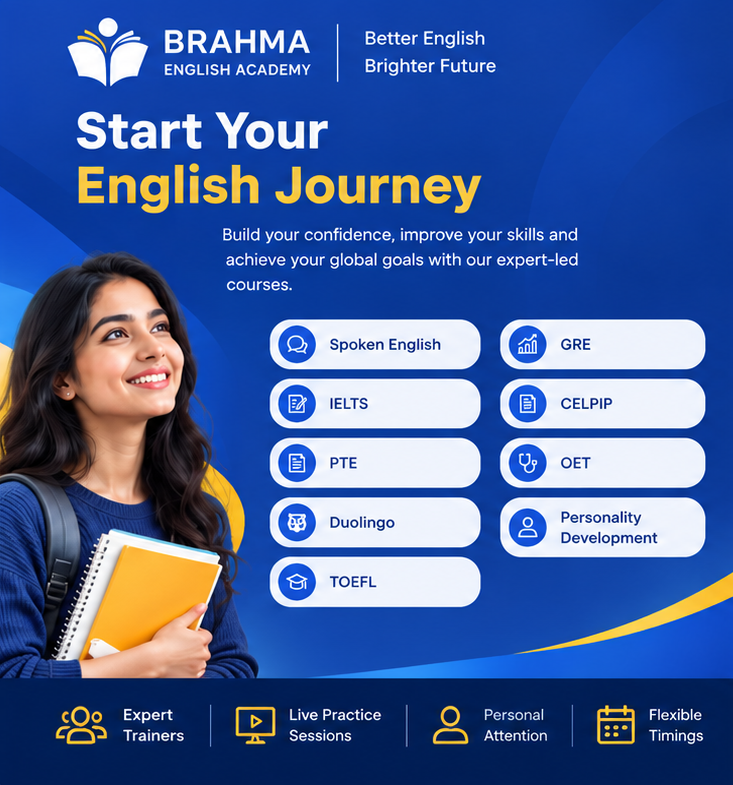
At Brahma English Academy, students receive personalized guidance, practical communication training, and expert support designed to build confidence in speaking, listening, reading, and writing.
Whether you’re preparing for IELTS, improving workplace communication, or enhancing your overall English fluency, structured training can help you achieve your goals faster and more effectively.
Start Your IELTS Journey Today
📍 Pune, Maharashtra
📞 Call / WhatsApp: +91-8855829557
🌐 Website: www.brahmaenglishacademy.com

Learners who practice regularly for just 30 minutes each day should expect to notice significant gains in both fluency and understanding the language within 4-8 weeks, depending on where they begin their language studies, how often and for how long they practice; not simply time spent practicing.
Daily speaking, listening and feedback practices produce results quickly; one such practice is known as shadowing: copying the speech cadence and musicality of rhythm of your target language in order to quickly improve fluency of speech. Shadowing can help improve fluency of your speaking more rapidly.
Although apps, AI writing tools, and other resources can make significant improvements, the best way to learn a language remains getting feedback from someone who already mastered it.
Most groups of learners prioritize fluency and listening skills over any other abilities as these impact directly the quality of interactions conducted in real time. Reading and writing should act as supports in developing these capabilities concurrently.
Take every opportunity to practice English-speaking tasks--sending emails, attending and leading meetings, giving and attending presentations--in English. When possible, utilize opportunities to practice this language--sending emails, attending and leading meetings, giving and attending presentations as well as collecting pieces that need polishing using grammar/spell checking tools; utilize trustworthy peers/colleagues who support this initiative while monitoring how the best communicators in your workplace communicate their messages effectively.
Get expert guidance, personalized study plans, and real exam strategies
to crack IELTS, PTE, TOEFL & more with confidence
IELTS Coaching classes in Pune
IELTS Classes in Pune
IELTS Training center in Pune
IELTS coaching classes in Balaji Nagar, Pune
IELTS coaching classes in Katraj, Pune
IELTS coaching classes in Ambegaon Budruk, Dattanagar, Pune
IELTS coaching classes in Kondhwa, Pune
IELTS Coaching classes in Karve Nagar , Pune
IELTS coaching classes in Nanded City, Pune
IELTS coaching classes in Baner, Pune
IELTS coaching classes in Viman Nagar, Pune
IELTS coaching classes in Wadgaon Sheri, Pune
IELTS coaching classes in Gokhale Nagar, SB Road, Pune
IELTS coaching classes in Deccan, FC Road, Pune
Email
info@bramhaenglishacademy.com
Phone
8484819557 | 8485829557
8485859557 | 8485819557
8484829557 | 8412919557
9119443775


