




7.5

Expert Trainers

Proven Strategies

High Success Rate
 Proud Moment!
7.5

8.0

8.0

6.5

7.0
you can be next!

Trusted by 1000+ Students

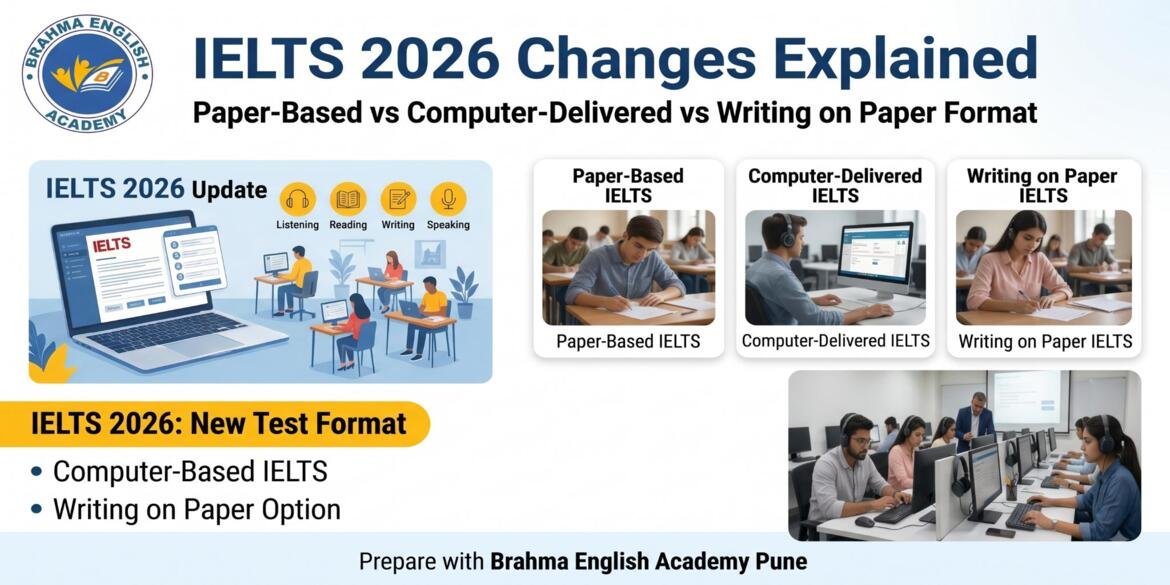
The main IELTS 2026 changes are about delivery, not difficulty. From mid-2026, the IELTS Partners are retiring the paper-based test, so IELTS exams will move to computer-based delivery, with a new “Writing on Paper” option available in selected markets. The syllabus, four sections, question types, and 0–9 band scale remain unchanged.
Let me settle this, because the panic circulating on YouTube and Telegram is damaging good candidates. The IELTS 2026 changes are genuine and officially confirmed—but almost every viral post about them is wrong. Nobody rewrote the syllabus. Nobody added new question types. What changed is how you sit the exam, not what it asks you.
I have spent months retooling our IELTS batches at Brahma English Academy around this shift. Here is the accurate version, directly based on the official announcement.
On 5 March 2026, the IELTS Partners—the British Council, IDP IELTS, and Cambridge University Press & Assessment—announced that from mid-2026, IELTS will no longer be offered as a paper-based test. Every IELTS exam will be administered via computer, with the precise transition timeline differing depending on the market. In certain markets, a “Writing on Paper” option is also being introduced.
The reasoning is stated plainly: the IELTS Partners found higher satisfaction among test takers choosing IELTS on computer because it is more convenient, results arrive faster, and it offers One Skill Retake.
So this is a delivery decision, not an academic one. The official wording is unambiguous—the update does not change the IELTS skills assessed, the test construct, or the way results should be interpreted by institutions. That one point should reassure every Pune candidate who has already invested in IELTS preparation materials.
A few important operational details include:
No. The IELTS syllabus has not changed in 2026. Listening remains approximately 30 minutes with 40 questions, Reading remains 60 minutes with 40 questions, Writing remains 60 minutes across two tasks, and Speaking remains approximately 11–14 minutes. The band descriptors, the 0–9 scoring scale, and the Academic versus General Training distinction remain unchanged.
Let me be blunt, because misinformation can cost students both time and money. Posts claiming there are “12 new IELTS rules” or completely “revised band descriptors” are often aggregator content rather than official announcements. Always check such claims against the official IELTS information before changing your preparation strategy.
What genuinely changes for you is the way you interact with the test:
None of these changes requires you to learn new English. They require a different set of test-taking habits and digital muscle memory—and that is exactly what structured IELTS preparation can help you build faster than practising blindly on your own.
If your test date falls after your local centre completes the transition, computer-delivered IELTS will be your default option. Choose “Writing on Paper” only if handwriting genuinely helps you plan and write essays and the option is available in your market. UKVI SELT candidates have no choice because the test is fully digital only.
| Feature | Paper-Based (Being Retired) | IELTS on Computer | Computer + Writing on Paper |
|---|---|---|---|
| Availability from mid-2026 | Withdrawn | Standard everywhere | Selected markets only |
| Writing Component | Handwritten | Typed on screen | Handwritten |
| One Skill Retake | Not available | Available | Available (same mode only) |
| Result Turnaround | Slower | Faster | Faster |
| Valid for UKVI SELT | No | Yes | Fully digital required |
| Score Comparability | — | Confirmed comparable | Confirmed comparable |
That last row deserves emphasis: IELTS Partner research shows that scores are comparable across formats, both overall and within each individual band. Neither route automatically penalises you, so choose the format that suits both your hands and your head.
One Skill Retake allows you to retake just one IELTS section—Listening, Reading, Writing, or Speaking—instead of repeating the entire test. You must have taken a full IELTS on Computer test at a participating centre, complete the retake within 60 days of your original test, and you can use the option only once per original test. Results are typically available within 3–5 days.
This is one of the most useful parts of the IELTS 2026 changes, particularly for Indian candidates who are close to their target band but have one weaker section.
Picture the classic Pune profile: Listening 8.0, Reading 8.0, Speaking 7.5, and Writing 6.0. Previously, a Writing score of 6.0 could mean taking the entire test again, spending another full test fee, and risking your stronger section scores. With One Skill Retake, you can retake Writing alone.
You receive a new Test Report Form showing the updated score alongside your three original results, and you can choose which result to submit. One Skill Retake is available for both Academic and General Training, while UKVI acceptance depends on the relevant location and requirements. Always confirm the requirements with your receiving institution or organisation before relying on a retake result.
There is one important catch: if you choose Writing on Paper, your One Skill Retake for Writing must also use the Writing on Paper format. You cannot switch between the two Writing modes.
Here is where the IELTS 2026 changes become practical for candidates preparing in Pune.
Meet Sanika, a B.Sc. Nursing graduate from Dhayari (composite profile). She studied in a Marathi-medium environment and was targeting Band 7 for the UK. Her first computer-mode mock test collapsed—not because her English was weak, but because she typed approximately 19 words per minute and lost around eleven minutes of Task 2 time while searching for keys. After six weeks of daily typed practice, she was completing 250-word essays comfortably within the time limit. Her English never changed. Her familiarity with the interface did.
Meet Rohit, an IT professional from Hinjewadi (composite profile). He already typed around 60 words per minute and assumed computer IELTS would be easy. His real problem was Reading. He was trained to underline important information with a pencil, and on screen he repeatedly went back to the same paragraphs. After learning the available highlighting tools and practising scanning techniques, his Reading score improved from 6.5 to 7.5.
These are two different learners with the same lesson: under the new IELTS pattern in 2026, familiarity with the test format and digital interface has become an important part of preparation.
Add the mother-tongue patterns we regularly correct in our Pune classrooms—the /v/ and /w/ sound confusion in words such as very and worry, missing articles, and direct Marathi-to-English sentence structures such as “I am having 5 years experience”—and it becomes clear why generic online videos often fail to move a candidate’s band score. Targeted feedback and focused practice can make the difference.
| Week | Focus | What Success Looks Like |
|---|---|---|
| 1–2 | Diagnostic + interface familiarisation | Comfortable with on-screen highlighting, notes, and word count |
| 3–4 | Module strategy: Reading scanning, Listening prediction | Reading passages completed within 20 minutes each |
| 5–6 | Writing under typed conditions + Speaking fluency drills | Task 2 planned and typed in 40 minutes |
| 7 | Full-length computer-mode mock tests | Consistent scores within 0.5 of target band |
| 8 | Error correction, pronunciation polish, mock interviews | Confident, unrehearsed Speaking responses |
Most candidates who practise daily and attend weekly mocks see meaningful movement within this window. This is a trainer-observed pattern across our batches, not a guarantee. Your starting level matters enormously.
Self-study worked when the format was static and every free PDF available online accurately reflected the test. In a transition year, that logic breaks down.
At Brahma English Academy, our IELTS coaching in Pune runs in batches capped at 15 learners, with daily speaking practice, group discussions, role plays, debates, mock interviews, and weekly full-length mocks under computer-delivered conditions. Madhav More and the Brahma training team provide written feedback on every Writing task because simply saying “your essay is good” has never improved anyone’s Task Response score.
We also run [Internal Link: PTE Classes] and [Internal Link: Spoken English Course] batches if a diagnostic assessment shows that another English test is more suitable for your goals. That conversation is free.
Candidates who struggle during a transition year rarely have weak English. More often, they prepared for the wrong format or trusted a viral post instead of an official announcement.
Understanding the IELTS 2026 changes is step one. Training under the new conditions is step two—and that is where structured coaching earns its value.
Book your free demo class with Brahma English Academy today. Take a diagnostic test in computer-delivered mode, receive an honest band prediction from Madhav More and the Brahma training team, and leave with a preparation plan built specifically for the format you will actually face.
📞 Call or WhatsApp: 8484819557
🌐 brahmaenglishacademy.com
Small batches. Daily speaking practice. Morning, evening, and weekend batches, online and offline—serving Kothrud, Katraj, Kondhwa, Baner, Hinjewadi, Dhayari, Nanded City, and Pimpri-Chinchwad.

No, the IELTS syllabus is not changing in 2026. The IELTS Partners confirmed that the update to test delivery does not change the skills assessed, the test construct, or how results are interpreted by institutions. Listening, Reading, Writing and Speaking keep their existing formats, timings and band scale.
Paper-based IELTS is being withdrawn from mid-2026, with exact timelines varying by market. The IELTS Partners announced this on 5 March 2026. Rollout differs by test centre, so check yours on the official IELTS booking page.
Yes, your existing paper-based IELTS result remains completely valid. The IELTS Partners confirmed all current paper-based results are unaffected and remain valid until the end of the recommended two-year period. You need not retake the test because of the format change.
No, computer delivery does not lower your band score. Official IELTS research found scores are comparable across formats, both overall and within each band. Any difference candidates experience usually comes from interface unfamiliarity, which practice resolves.
Writing on Paper is a new option letting you handwrite your Writing answers while taking the rest of your IELTS on computer. It is being introduced in selected markets. If you choose it, any One Skill Retake for Writing must also be taken in Writing on Paper mode.
Get expert guidance, personalized study plans, and real exam strategies
to crack IELTS, PTE, TOEFL & more with confidence
IELTS Coaching classes in Pune
IELTS Classes in Pune
IELTS Training center in Pune
IELTS coaching classes in Balaji Nagar, Pune
IELTS coaching classes in Katraj, Pune
IELTS coaching classes in Ambegaon Budruk, Dattanagar, Pune
IELTS coaching classes in Kondhwa, Pune
IELTS Coaching classes in Karve Nagar , Pune
IELTS coaching classes in Nanded City, Pune
IELTS coaching classes in Baner, Pune
IELTS coaching classes in Viman Nagar, Pune
IELTS coaching classes in Wadgaon Sheri, Pune
IELTS coaching classes in Gokhale Nagar, SB Road, Pune
IELTS coaching classes in Deccan, FC Road, Pune
Email
info@bramhaenglishacademy.com
Phone
8484819557 | 8485829557
8485859557 | 8485819557
8484829557 | 8412919557
9119443775


